
Scientific Notation and Standard Forms Game for 7th Grade: Coffee Quiz Challenge
Seventh graders step into more advanced mathematical concepts, and one of the biggest leaps they take is learning how to work with scientific notation and standard form. Whether they’re dealing with extremely large numbers like the distance to the sun, or extremely tiny numbers such as the size of microorganisms, scientific notation helps students express numbers efficiently and understand scale. To make this topic fun, memorable, and skill-boosting, the Scientific Notation and Standard Forms Game for 7th Grade – Coffee Quiz Game brings a refreshing twist to learning.
In this interactive game, students enter a cozy, coffee-themed quiz café where each question acts like a “brew order.” The faster and more accurately they convert between scientific notation and standard form, the more “coffee points” they earn. The game blends mental math, quick thinking, and strategy into a warm, friendly environment that helps even struggling learners understand these concepts with confidence.
Why Scientific Notation Matters in 7th Grade
Scientific notation is more than just a formatting skill—it develops essential mathematical thinking. By practicing scientific notation, students learn:
- How to represent large and small numbers concisely
- How powers of 10 work in real-life situations
- How to compare very big or very tiny quantities
- How to express values used in science, astronomy, biology, and physics
- How to see patterns in exponential growth and decay
The Coffee Quiz Game turns what could be an intimidating concept into an enjoyable learning experience that keeps students coming back for “another round.”
How the Coffee Quiz Game Works
The game is set inside a warm, animated coffee shop where players act as baristas, preparing the right “math orders” for customers by solving scientific notation problems.
- Students choose their coffee avatar (espresso hero, latte wizard, mocha mage, etc.).
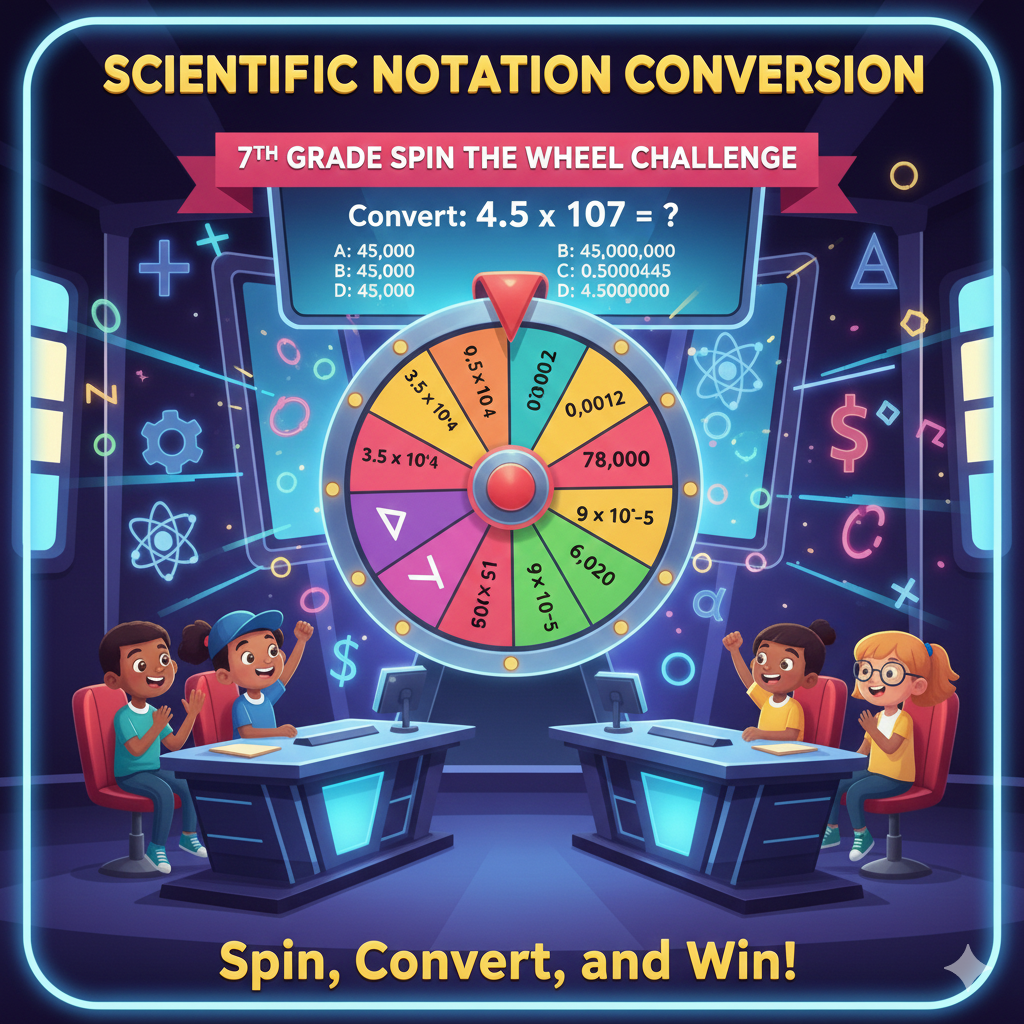
- They spin a virtual “Coffee Wheel” to determine the difficulty level of their next question.
- Each customer order is a scientific-notation-related challenge. Example: “Convert 3.2 × 10⁴ to standard form.”
- Correct answers earn coffee beans, points, badges, or drink upgrades.
- Incorrect answers send players to the “Cold Brew Zone” for a quick correction challenge.
- Bonus rounds introduce speed questions or real-world scenarios.
- The goal is to earn the title of ‘Master Barista of Numbers’ by mastering conversions.
The theme creates a relaxing yet competitive atmosphere that keeps students mentally engaged.
Types of Scientific Notation Challenges in the Game
The Coffee Quiz format includes a mix of question types that encourage conceptual understanding and flexible thinking:
- Basic conversions to standard form: 5.6 × 10³
- Converting small decimal numbers: 4.2 × 10⁻⁵
- Converting standard form to scientific notation: 0.0049 → 4.9 × 10⁻³
- Comparing magnitudes: Which is larger—3.1 × 10⁶ or 8.5 × 10⁵?
- Place value reasoning: Move the decimal correctly based on the exponent.
- Real-world problems: “The population of a city is 2.7 × 10⁷. What is it in standard form?”
- Trick questions: Numbers like 10.5 × 10⁴ that must be rewritten properly.
These challenges ensure students master both directions of conversion—and develop flexibility with exponents.
Why the Coffee Theme Works So Well for 7th Graders
A cozy coffeehouse setting might seem simple, but it works brilliantly for middle school learners who want math activities that feel more grown-up and less childish.
1. Relaxed Environment Reduces Math Anxiety
Students feel like they’re in a café rather than a classroom, helping them stay calm while solving complex conversions.
2. Gamified Rewards Keep Them Motivated
Coffee beans, badges, and drink upgrades give a sense of achievement—every correct answer feels like progress.
3. The Wheel Spin Creates Suspense
Students love randomization. They never know whether their next challenge will be “Espresso Easy,” “Cold Brew Challenge,” or “Cappuccino Expert Level.”
4. Encourages Quick Mental Math
Many challenges must be solved rapidly, sharpening fluency with exponents and decimals.
5. Perfect for Individual or Team Play
Teams can compete to earn the most beans, creating a social, collaborative learning atmosphere.
Example Coffee Challenges Students Will Encounter
Here are a few sample quiz questions from the Coffee Quiz Game:
- Convert to standard form: 7.2 × 10²
- Write in scientific notation: 0.000067
- Which is greater? 5 × 10³ or 4 × 10⁴
- Evaluate: 9.1 × 10⁻³
- Correct or incorrect? 52000 = 52 × 103
- Real-world example: A bacteria colony grows to 3.5 × 10⁸. What is the number in standard form?
- Fix the notation: 12.6 × 10⁵
These represent the exact skills students need for pre-algebra, science, and standardized tests.
How Teachers Can Use the Coffee Quiz Game
Teachers can use the game during:
- Warm-ups before scientific notation lessons
- Group competitions or math centers
- End-of-unit review sessions
- STEM enrichment blocks
- Homework replacement activities
Students remain focused longer because the game format feels exciting and refreshing.
How Parents Can Use the Game at Home
At home, the Coffee Quiz Game makes learning feel relaxing and enjoyable. Students can:
- Practice conversions without pressure
- Review for quizzes or tests
- Build confidence with exponents
- Challenge family members in a fun competition
It helps reinforce school lessons and improves fluency through short, consistent sessions.
Final Thoughts: Making Scientific Notation Fun, Warm, and Engaging
The scientific-notation-and-standard-forms-game-for-7th-grade-coffee-quiz-game blends cozy café vibes with high-energy math practice to help students master scientific notation effortlessly. Through quizzes, wheel spins, rewards, and challenge rounds, 7th graders learn how to convert, compare, and interpret numbers written in scientific and standard form.
By making learning feel like a relaxing café game instead of a stressful math lesson, this activity builds confidence, improves accuracy, and prepares students for higher-level math and science concepts. It is the perfect tool for helping students see the beauty and usefulness of scientific notation.

Leave a comment
This site is protected by hCaptcha and the hCaptcha Privacy Policy and Terms of Service apply.