Multiplication Game for 2nd Grade: Snakes and Ladders Adventure
For many children, 2nd grade is the first time they are introduced to the exciting world of multiplication. This foundational skill sets the stage for all future math topics, including division, fractions, multi-step problem-solving, and algebraic thinking. Because multiplication can feel intimidating at first, the Multiplication Game for 2nd Grade – Snakes and Ladders Game transforms learning into a fun, interactive, and motivating adventure where kids explore multiplication facts while climbing ladders and avoiding sneaky snakes.
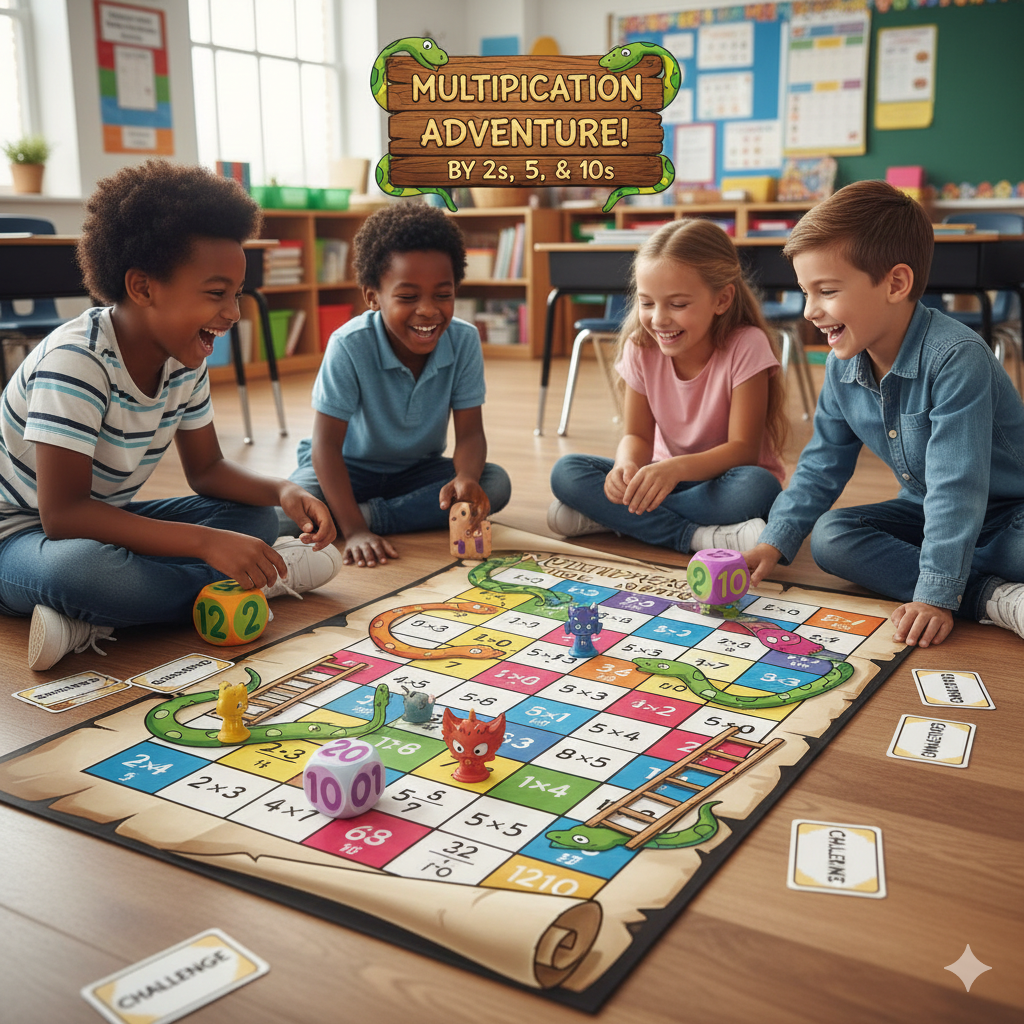
This upgraded version of the classic Snakes and Ladders board game blends hands-on movement, colorful visuals, and strategic thinking to make multiplication practice easy and enjoyable. Each roll of the dice takes students across a board filled with multiplication challenges that reinforce fluency, pattern recognition, and early number sense. Whether at home or in the classroom, this game helps children build confidence with multiplication in the most exciting way.
Why Learning Multiplication in 2nd Grade Matters
Multiplication is not just another math topic—it is a core building block for everything that follows in elementary and middle school math.
- Supports repeated addition: Helps children understand groups, sets, and equal sharing.
- Builds mental math: Multiplication boosts speed and efficiency in calculations.
- Prepares for division and fractions: Understanding multiples makes complex ideas easier later.
- Strengthens number patterns: Kids recognize multiplication facts as predictable patterns.
- Improves word problem solving: Real-life scenarios often involve multiplication concepts.
By practicing multiplication through play, 2nd graders develop the fluency and confidence they need for future success.
How the Snakes and Ladders Multiplication Game Works
This multiplication game uses the familiar Snakes and Ladders format but includes math challenges at every step of the journey.
- Each player chooses a game piece and starts at square one.
- Players roll the dice to move forward across the game board.
- When a player lands on a square, they must answer a multiplication question.
- If correct, they stay on the square—or climb a ladder if they land on one.
- If incorrect, they may slide down a snake or move back spaces.
- Ladders represent “bonus rounds” with trickier multiplication problems.
- Snakes act as challenges that test deeper understanding of multiplication patterns.
- The first player to reach the finish wins the game!
The excitement of climbing ladders and avoiding snakes keeps kids focused and motivated throughout gameplay.
Types of Multiplication Challenges in the Game
The game includes a variety of multiplication tasks that gradually increase in difficulty:
- Basic multiplication facts: 2 × 3, 4 × 2, 5 × 1
- Repeated addition: 3 + 3 + 3 = ?
- Skip-counting-based multiplication: Counting by 2s, 3s, or 5s to find the product.
- Fill-in-the-blank: 2 × __ = 8
- Multiplication puzzles: match the product with the correct fact.
- Word problems: “You have 3 bags with 4 apples each. How many apples?”
These challenges reinforce multiplication understanding through repetition, visual cues, and pattern recognition.
Why Snakes and Ladders Is Perfect for Multiplication Practice
Young learners thrive when math feels like play. Snakes and Ladders works beautifully for multiplication because it brings energy and movement into math practice.
1. Encourages Active Engagement
Kids stay excited because every roll of the dice could launch them up a ladder or down a snake—keeping them alert and involved.
2. Creates Natural Repetition
Players answer many multiplication questions while trying to win, building fluency without boredom.
3. Blends Strategy and Learning
While the game involves luck, kids also build strategy by anticipating outcomes and remembering facts.
4. Makes Math Social and Collaborative
Learning with friends or classmates encourages discussion: “How did you solve that?” or “Let’s try again!”
5. Reduces Math Anxiety
Kids who fear math worksheets become more open to learning when it feels like a game instead of an assignment.
Skills Strengthened Through the Game
The Snakes and Ladders multiplication game strengthens several foundational skills:
- Understanding equal groups
- Multiplication fact fluency
- Skip counting by 2s, 3s, 4s, and 5s
- Building number patterns
- Mental math skills
- Critical thinking
- Early problem-solving strategies
These skills create the groundwork for 3rd-grade multiplication mastery.
Example Multiplication Problems Kids May Encounter
During gameplay, 2nd graders may solve questions like:
- 2 × 4 = ?
- What is 5 groups of 3?
- Skip count by 2s up to 16.
- Is 4 × 2 the same as 2 × 4?
- Fill in the blank: 3 × __ = 12
- If you have 2 boxes with 5 toys each, how many toys?
These questions help students develop both conceptual understanding and fact fluency.
How Teachers Can Use This Game in the Classroom
Teachers can integrate the Snakes and Ladders multiplication game during:
- Math center rotations
- Warm-up activities
- Small-group instruction
- Partner practice
- Fact fluency intervention
- Fun Friday math games
The social nature of the game helps students discuss math, explain reasoning, and build teamwork.
How Parents Can Use the Game at Home
At home, parents can use the game to make math practice more enjoyable. Kids can:
- Play with family members
- Practice multiplication without worksheets
- Strengthen skip counting and grouping skills
- Gain confidence with numbers in a playful way
Kids often ask to play again—creating natural, repeated multiplication practice.
Final Thoughts: Making Multiplication Fun Through Gameplay
The multiplication-game-for-2nd-grade-snakes-and-ladders-game brings multiplication to life through movement, challenge, and excitement. Students learn multiplication facts while climbing ladders, dodging snakes, and solving problems in a playful setting.
With consistent gameplay, 2nd graders quickly build stronger multiplication foundations that support future math success. The blend of fun and learning makes this game one of the most effective tools for teaching multiplication in early elementary school.

Leave a comment
This site is protected by hCaptcha and the hCaptcha Privacy Policy and Terms of Service apply.